RAS Spring Lecture 2026

about our speaker & this talk
We are delighted to have Dr. Warren Douglas Allmon as our speaker. Dr. Allmon is currently the Director of the Paleontological Research Institution since 1992 and Adjunct Associate Professor in Cornell University’s Department of Earth and Atmospheric Sciences in Ithaca, NY.
Natural history museums are sometimes seen as dusty anachronisms or little more than places to take the kids on a rainy day. On the contrary, they and the collections they contain are critical for addressing some of the most important challenges facing humanity today. They are essential tools for understanding the diversity and history of life and how the Earth works, and for educating people of all ages about the natural world and how we can sustain it.
The role of natural history museums is in addressing global challenges like climate change and the biodiversity crisis. He emphasizes that these institutions are not just repositories of the past but are critical for understanding the "future of the world" through education and scientific data.
They are essential for several reasons:
Climate Change Education: Museums like the Museum of the Earth use paleontology to show how rapidly humans are changing the climate compared to historical patterns. The fossil record is not merely a catalogue of extinct life but a critical predictive datasetfor managing Earth's future. It offers millions of years of "natural experiments" where the Earth tested the very conditions—high CO₂, ocean acidification, and rapid warming—that we are creating today. By observing past rapid climate events in the fossil record, we can predict future ecosystem responses.
Scientific Evidence: Natural history collections serve as the "final physical evidence" for the history of life, providing a baseline to measure future biological changes.
Digital Accessibility: To remain relevant, PRI has expanded its online reach to over 1.2 million annual visitors, providing global access to its research collections.
The lecture is free to the public. We hope you will come! Invite your friends.
MEMBERS OF THE RAS: For information on the RAS Annual Meeting click here.
Directions
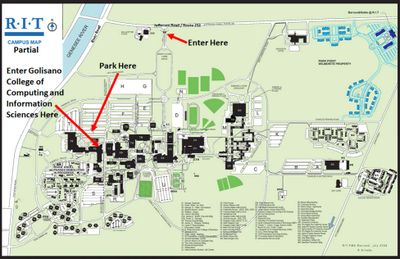
RIT is southwest of Rochester at One Lomb Memorial Drive, Rochester, NY 14623-5603, off Jefferson Road. When you reach Lomb Memorial Drive, enter the campus there, then bear to the right when reaching Andrews Memorial Drive (the ring road around campus). Parking is in Lot J. Golisano College of Computing and Information Sciences is due south of the parking lot. The auditorium, Room 1400, is on the first floor.